
Solar arithmetic Pt. 2
How to "win" a debate without solving anything

⚡ TL;DR
Are 20 GW of solar equivalent to “20 nuclear plants”? Such claims stack three old tricks: swapping energy for capacity, delivery for growth, and the whole system for electricity alone.
Renewables matter, but pretending physics doesn’t exist helps no one, least of all the transition.
The first principle is that you must not fool yourself - and you are the easiest person to fool. So you have to be very careful about that.
- Richard P. Feynman
Last week, I had an interesting exchange on 𝕏. It all started with a loud headline from the italian newspaper Il Corriere della Sera, claiming that a new solar technology could deliver “the energy of 20 nuclear plants.”
The number behind the claim?
20 gigawatts (GW) of solar capacity 👇
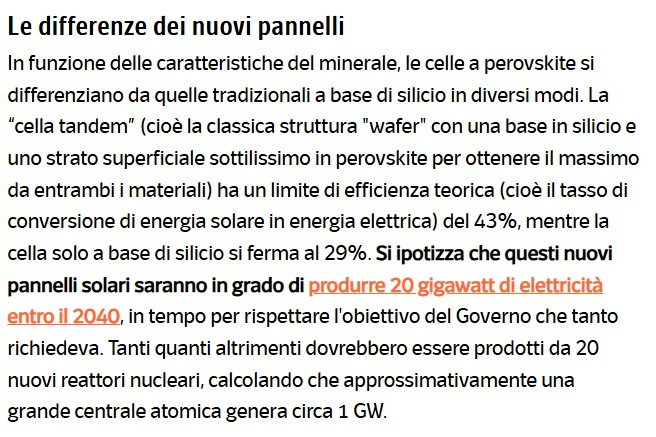
This is where the energy debate goes to die.
It’s honestly remarkable that we still have to clarify things like this. But as long as energy is treated like a spectator sport, where you pick a team and cheer every time your side scores a goal, we’ll keep distorting metrics just to “own” the other camp.
Hooligan logic, in fact, guarantees confusion.
The Il Corriere article (and the debate that followed) hinges on three old sleights of hand, used together:
Replacing energy delivered with capacity installed
Replacing energy delivered with growth in annual output
Finally, adding a tight frame on electricity alone (= 20% of global primary energy)
Once you line them up like this, almost anything can be made to look impressive.
Now, let’s be clear: renewables do have a role to play in the energy transition. They already do. Solar and wind have reduced marginal costs in certain hours, diversified supply, and (where conditions and grids allow) added useful, low‑carbon electricity.
Ignoring that would be just as sloppy as exaggerating their impact.
But resorting to these sleights of hand does renewables a bad service, because it avoids the hard part of the discussion: the very real challenges that come with their physical characteristics, not with bad intentions or lack of goodwill.
The moment we stop talking about integration costs, reliability, and system value, we end up outsourcing the heavy lift to legacy generators, grid operators, storage assets, or ourselves (the consumers) paying higher costs.
What now?
As you might recall, we have touched upon the slight of hands above on TN&B:

But simply pointing at data isn’t enough. The data show that these claims are wrong, but the more important question is why they are wrong.
That’s why I’ve decided to write more about these supposedly “basic” ideas: power vs. energy, capacity vs. reliability, growth vs. delivery. They sound simple because we’ve memorized some jargon. But understanding them means wrapping our heads around what changes when, what accumulates, and what is required at every instant.
The grid doesn’t care what a generator is called or how fast it’s growing.
It must balance power, not energy, every second. At every moment, generation has to match load. When it doesn’t, frequency drifts. Drift too far, protection systems trip, and parts of the grid shut down. We’ve seen this happen - el apagón wasn’t a thought experiment.
(By the way, if you’re interested in an honest, technically grounded deep dive into how the Iberian blackout actually unfolded, and what it teaches us about grid resilience, I strongly recommend the post below from Post Normal Times by Emiliano Barin) 👇

The only question that really matters is simple, and unforgiving:
Does real power show up at the right time, every time?
Until we learn to ask this question carefully, we’ll keep getting confident answers to the wrong problem.
Transitions happen by solving real constraints.
And we’d do well to resist the temptation to make the numbers prettier than the system will allow.
More soon 👋
🧰 Toolbox
McKay D., Sustainable Energy - without the hot air, Green books, 2009
🙏 Glad to have you along for another edition of The Nuts and Bolts!
If this sparked a thought or two, share it with a friend! Or, give a quick tap on the ❤️ button to surface it to more curious readers on Substack.
See you on Friday.